
An Intelligible Universe and the Missing Piece
Written by Isla Madden
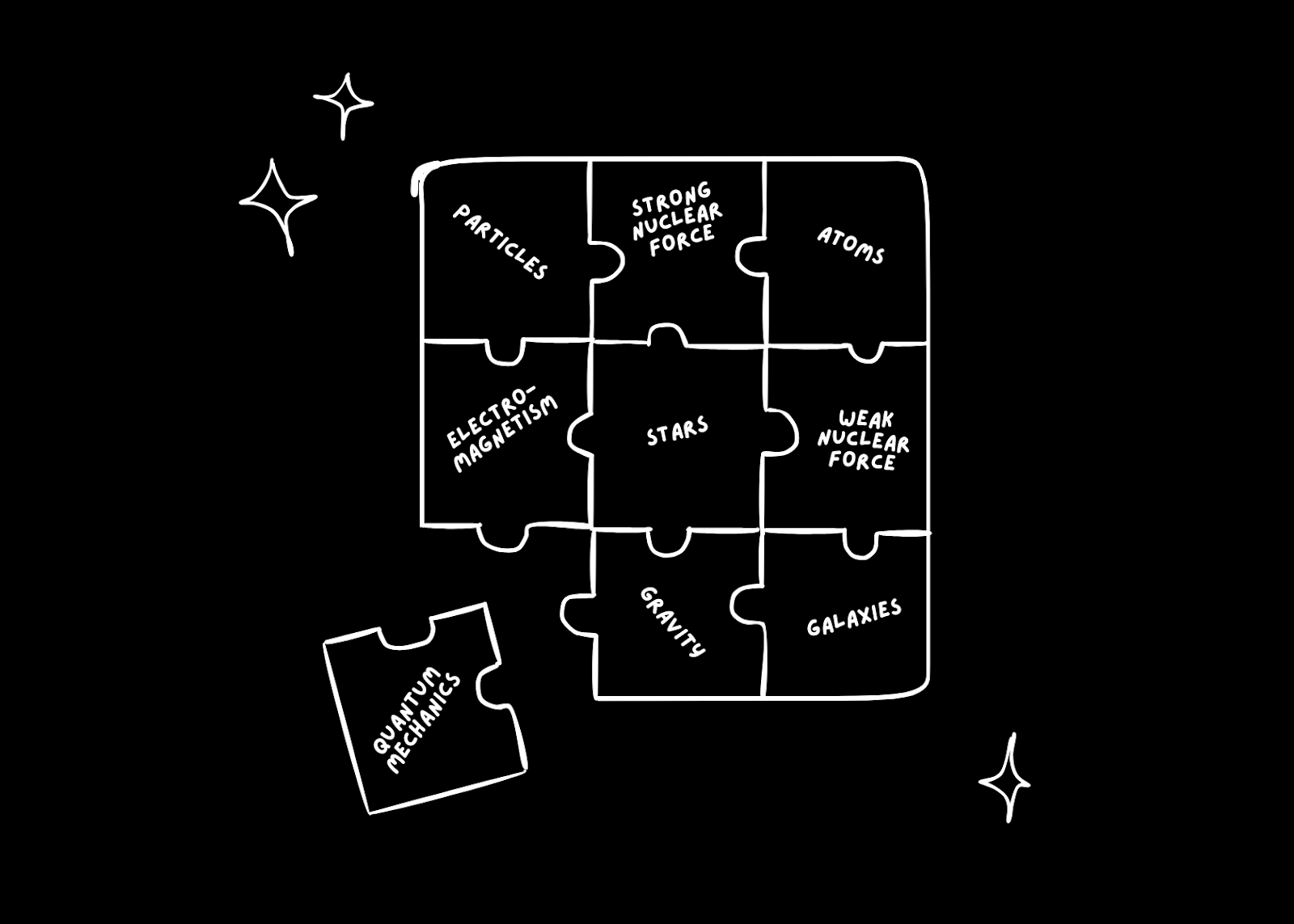
The coherence between theory and observation in cosmology suggests that the Universe is intelligible, with a structure that appears to be governed by consistent laws. Modern science unravelled the evolution of the Universe, from the first observable moments to the formation of vast cosmic structures, and eventually, observers. Within this current framework, there exists an unresolved puzzle. General relativity and quantum theory cannot currently be unified within a single consistent theoretical framework. This leaves the deepest origins of our Universe beyond the reach of current physics.
According to the cosmological model, our observable Universe expanded from an extremely hot, dense state approximately 13.8 billion years ago. As the expansion progressed, the Universe cooled. This cooling allowed fundamental particles to form, followed by atomic nuclei and neutral atoms. Over time, gravity amplified small density variations, leading to the formation of stars, galaxies, and the large-scale cosmic web. Modern Big Bang cosmology is supported by multiple independent lines of evidence, including the cosmic microwave background, large-scale galaxy distributions, and the observed element abundances of our primordial Universe.
The Big Bang represents the earliest epoch supported by observation and tested theory; however, the deeper regime remains open to future theoretical development. Despite having mapped early cosmic evolution, the story of our Universe is incomplete. Under the extreme conditions of our primordial Universe, the known laws of physics reach the limits of their applicability. The absence of a consistent theory unifying general relativity and quantum mechanics remains one of the central unresolved problems in fundamental physics.
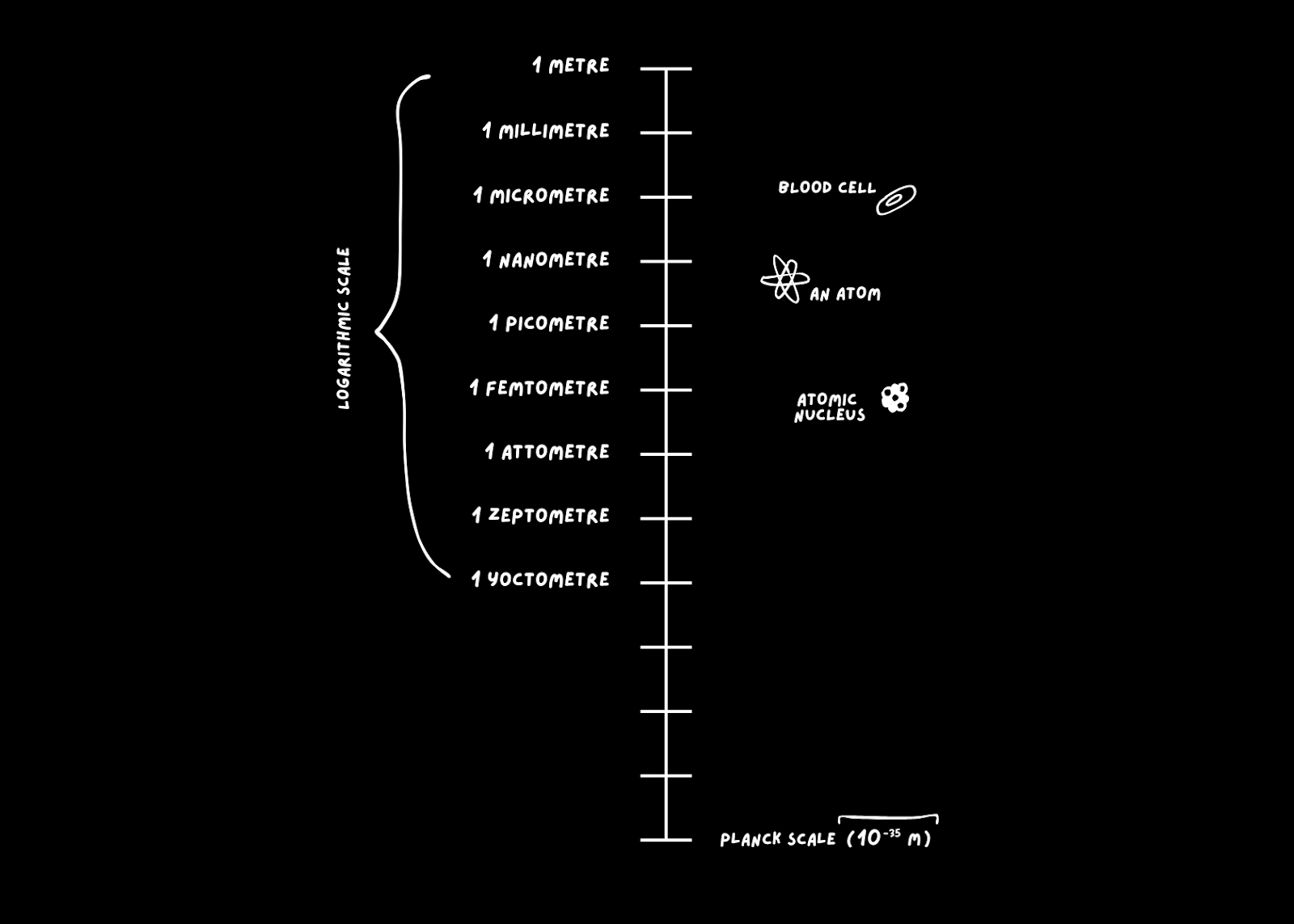
Within classical general relativity, the expansion of spacetime can be extrapolated backward toward extremely high densities and temperatures. However, at approximately 10-43 seconds after the extrapolated origin, known as the Planck time, quantum effects of gravity are expected to become significant. Beyond this scale, classical spacetime descriptions are no longer reliable. Because an experimentally verified theory of quantum gravity does not yet exist, our physical understanding of this regime remains incomplete.
General relativity models spacetime as a smooth geometric structure shaped by matter and energy. Quantum theory describes matter and energy as probabilistic fields governed by quantum principles. These frameworks are extraordinarily successful in their respective domains. However, near the Planck scale, neither framework alone is sufficient. Without such a theory, the earliest moments of cosmic history remain theoretically unresolved. The absence of a consistent theory of quantum gravity means that the classical singularity cannot be interpreted straightforwardly as a literal physical beginning. Instead, it marks the boundary of applicability of current theory.
In his book Physics and Philosophy: The Revolution in Modern Science, Werner Heisenberg wrote: “What we observe is not nature itself, but nature exposed to our method of questioning.” (Heisenberg, 1958). The nature by which the history of our Universe can be traced backward across billions of years through observation and theory is itself a testament to the profound intelligibility of the cosmos.
The search for quantum gravity represents the next step in understanding the earliest moments of cosmic history. Such a theory would not simply refine our picture of the beginning, but would complete the conceptual foundations underlying modern cosmology. In seeking the missing piece of quantum gravity, we are not just probing the earliest moments of time, but also tracing the threads of a cosmos whose intelligibility invites us to understand its deepest order.