
Before the Beginning of Time
Written by Isla Madden
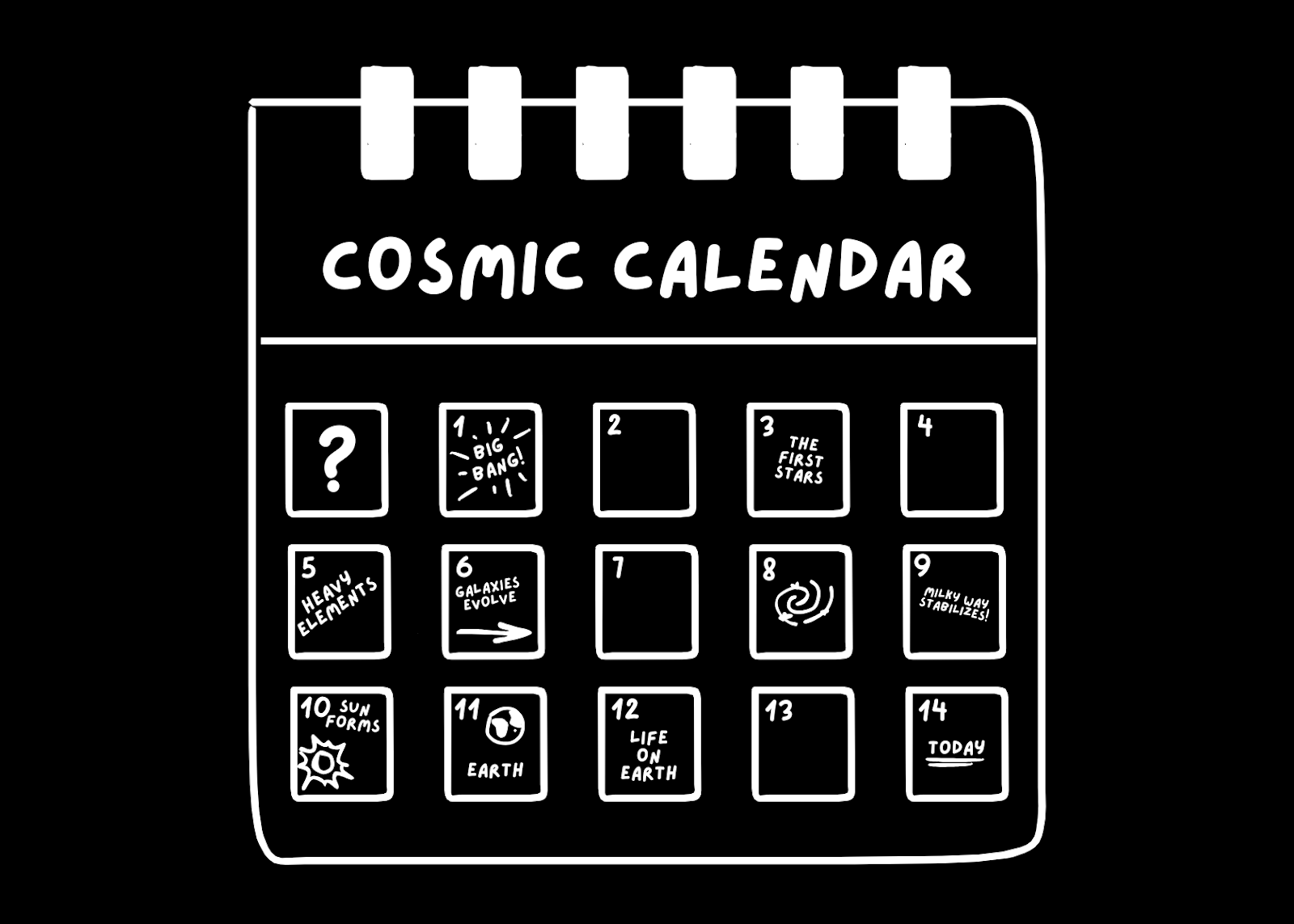
In his Timaeus, Plato describes the structure of the cosmos within his metaphysical framework: “Time is the moving image of eternity.” Plato believed there to be two levels of reality: 1. the eternal and unchanging world of ‘perfect’ forms; and 2. the dynamic, imperfect and a continuously changing physical world. In this view, time is the expression of eternal order through the motion and flux of the physical world, described as being created together with the heavens, arising as the cosmos began to move in a way that was structured and measurable.
The term “beginning” implies an event located within time. In standard cosmology, however, time is part of the spacetime structure described by general relativity. If spacetime itself is dynamical, then time is not an independent background against which events unfold. In that case, asking what happened “before” time may not correspond to a physically meaningful question. The concept of “before” presupposes temporal ordering.
If temporal ordering emerges only with spacetime, then the framework required to define “before” may not exist prior to it.Within classical general relativity, extrapolating backward leads to a boundary where the theory ceases to be reliable. Whether this mathematical limit corresponds to an actual origin of time, or simply to the breakdown of the classical model, remains an open scientific question.
One influential proposal addressing this issue is the no-boundary framework developed by Stephen Hawking and James Hartle. In this model, the early Universe is described using a mathematical continuation in which time behaves like a spatial dimension. The resulting geometry is finite but has no boundary, analogous to the surface of a sphere.
In this picture, there is no initial edge or singular starting point in the classical sense. The demand for a prior temporal moment becomes structurally similar to asking what lies north of the North Pole. The concept of a first instant dissolves within the geometry itself. Other cosmological models propose a bounce rather than a beginning. In these scenarios, a contracting phase precedes the current expansion, and quantum gravitational effects prevent singularities. Time would then extend beyond the hot early phase.
Inflationary cosmology complicates the question of origins. While inflation explains large-scale uniformity and structure formation, some formulations suggest it could be past-eternal, while others indicate limitations. Whether inflation extends infinitely backward remains unresolved.
Causation is typically defined as a relationship between temporally ordered events. If time itself has a finite boundary, then applying ordinary causal reasoning to the Universe as a whole becomes conceptually delicate. Cosmology does not currently require a cause outside spacetime in order to explain the early Universe. Rather, it describes how spacetime behaves under extreme conditions. The explanatory framework operates within physical theory, not outside it.
Contemporary cosmology provides a precise description of the Universe back to extremely early times, supported by observation. Whether the Big Bang represents the ontological beginning of time, a phase transition within a broader structure, or the limit of classical spacetime remains unresolved.
This uncertainty returns us to a philosophical perspective articulated long before modern physics. Time is not ultimate but derived from deeper order. In both cosmological and philosophical contexts, time appears not necessarily as a fundamental container of reality, but as something that emerges from structure, change, and physical law. The beginning of time may therefore be less a moment within reality than a boundary of description itself.