
The Fundamental Forces of Nature
Written by Isla Madden
While space may seem like an empty vacuum, the vast cosmos is rich with potential for the formation of matter, stars, planets—and, under the right conditions, life. The intergalactic medium is a diffuse plasma that accounts for approximately 90% of the Universe’s baryonic matter. Cosmological structures, galaxies, stars, planets, and the life that evolves on our Earth compose the remainder of observable matter. Underlying it all, the four fundamental forces—gravity, electromagnetism, and the strong and weak nuclear forces—govern the interactions of matter and energy that shape the Universe, giving rise to its structure, motion, and complexity.
In the first moments after the Big Bang, the Universe existed as an unimaginably hot, dense plasma of energy. Around 10⁻⁴³ seconds, all four fundamental forces were unified. As the Universe expanded and cooled, these forces separated in a sequence of symmetry breakings, forming the physical laws we observe today. Within the first microseconds, quarks and gluons formed a dense “quark–gluon plasma,” eventually combining to create protons and neutrons—the first building blocks of matter from which galaxies, stars, and planets would later emerge.
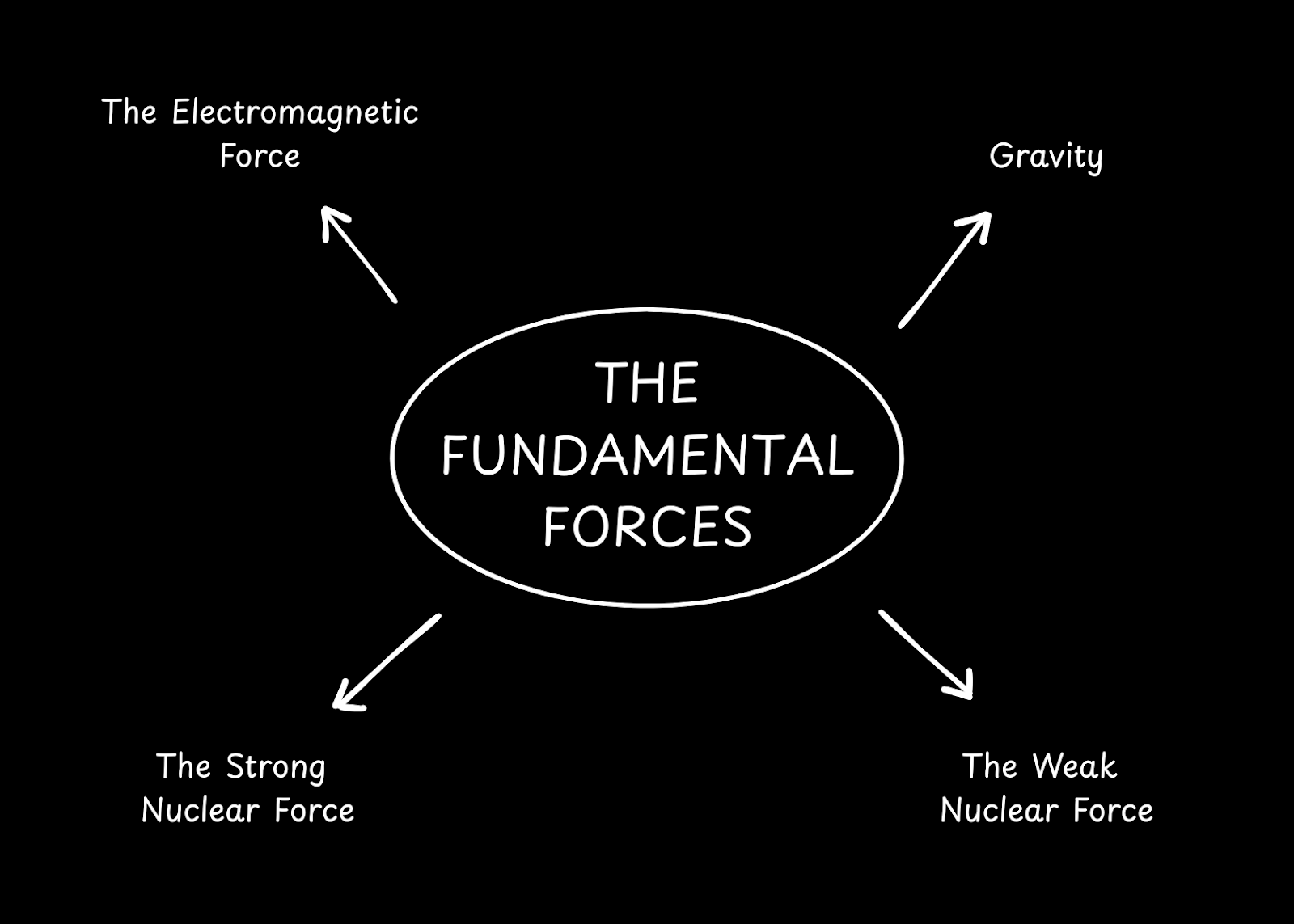
The strong nuclear force holds atomic nuclei together, overcoming the electromagnetic repulsion between positively charged protons. It operates only over extremely short distances—within the nucleus—and is immensely powerful. This force is carried by gluons, which bind quarks together to form protons, neutrons, and the matter we observe. The weak nuclear force is responsible for processes that change one type of subatomic particle into another, enabling the proton-to-neutron conversions necessary for nuclear fusion in stars, including our Sun, which helps produce the elements essential for life. Though short-ranged and subtle, the weak force facilitates the chemical diversity of the cosmos.
Gravity is the weakest yet most pervasive of the fundamental forces. It acts between all objects with mass, pulling them together. Though almost negligible at the atomic scale, gravity dominates the structure of galaxies, planetary orbits, and cosmic evolution—binding the Universe with its invisible embrace. The electromagnetic force acts between charged particles, both attracting and repelling, and underlies the formation of atoms, molecules, and chemical reactions. Light is a manifestation of the electromagnetic force, traveling through space as electromagnetic radiation carried by photons, the quantum particles of the force. This force governs nearly every interaction we experience at human and atomic scales, shaping the structure of matter and the visible Universe.
This idea of all things in the Universe being interconnected precedes the modern scientific understanding of the fundamental forces. The notion is expressed in Aristotle’s Physics, an exploration of nature, motion, and change: “Nature is a principle or cause of being moved and of being at rest in that to which it belongs primarily” (Aristotle, Physics, II.1, 192b). Heraclitus’ concept of Logos represents the rational structure which permeates the cosmos—a construct resonant with the nature of the fundamental forces which unify all natural phenomena.