
The Mysterious Nature of Time
Written by Isla Madden
Space and time form a single, four-dimensional fabric—spacetime. These four dimensions may be visualised as a river: space is the river’s water, and time is the current that directs the river’s flow. The arrow of time moves forward, connecting this seemingly abstract notion to the observable world. We divide time into uniform intervals—seconds, minutes, hours—and clocks keep track of its measurement each day, following the Earth’s rotation. This objective, quantifiable version of time allows us to coordinate our lives; however, the ticking of a clock is dependent on the observer’s reference frame.
Newton proposed that gravity was a force that acted instantaneously across space, pulling objects toward one another with a strength proportional to their masses. In his seminal work, Philosophiæ Naturalis Principia Mathematica (1698), Newton introduced the concept of time as a fixed, universal entity—an invisible stage upon which all events unfold, independent of motion, matter, or any external influence. In the Newtonian framework, time is absolute—like a steady river flowing uniformly throughout the Universe, unaffected by the objects within it.
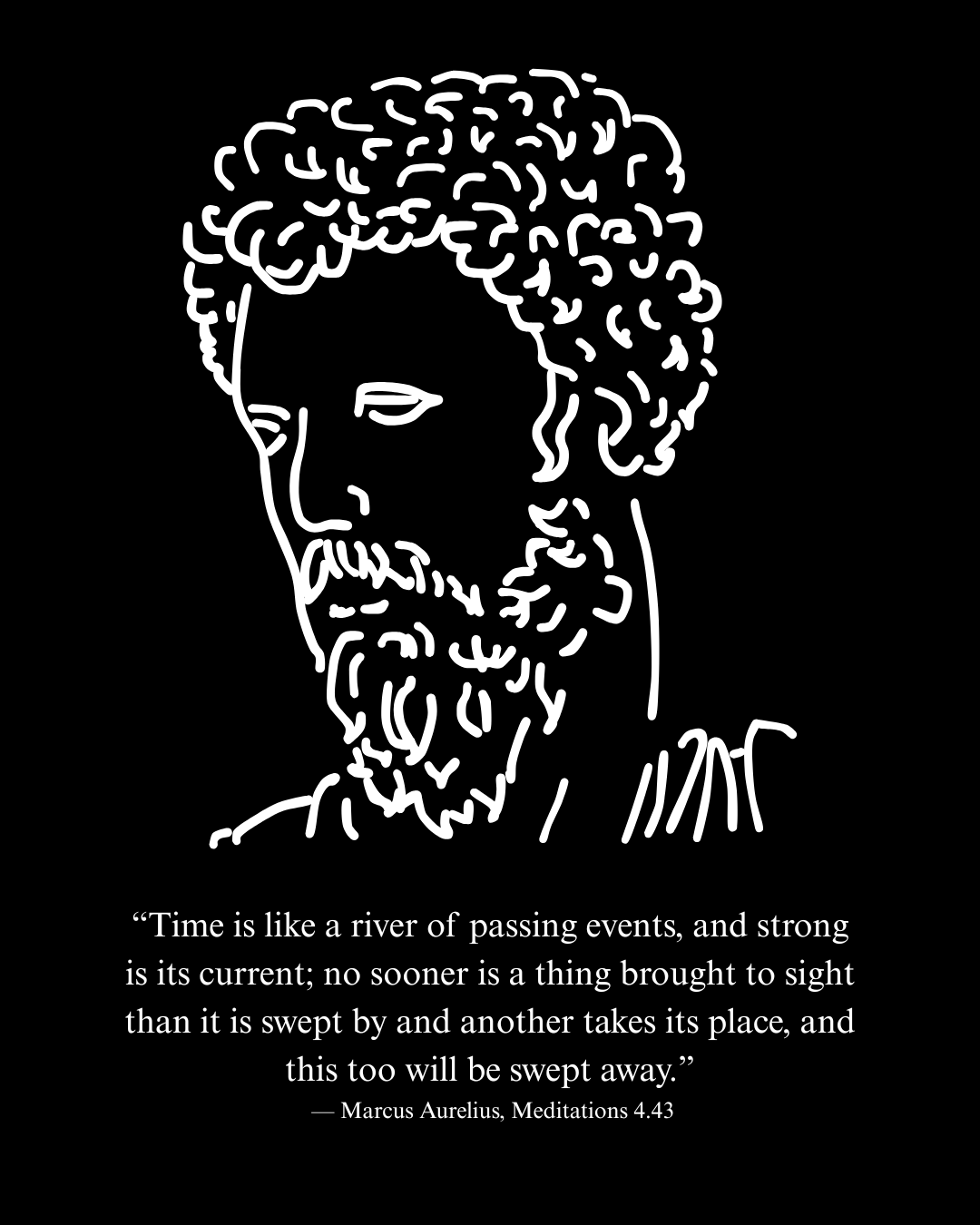
For over two hundred years, the Newtonian view reigned unchallenged, guiding everything from the calculations of astronomers to the trajectories of cannonballs. The vision of our predictive Universe was seemingly complete. Yet, we came to realise that space and time are not so predictable after all. Classical mechanics remained a robust framework for describing the motion of everyday phenomena; however, on large cosmological scales, a different set of rules applies.
As scientific understanding advanced, the prevailing view of gravity evolved. In 1915, Albert Einstein published his theory of general relativity, which redefined gravity not as a force acting at a distance, but as the curvature of spacetime caused by mass and energy. Massive objects distort this four-dimensional fabric, and smaller objects move along the curved paths—known as geodesics—created by that distortion. As the Universe expands, it stretches the fabric of spacetime, and with it, the wavelengths of photons travelling across it. Cosmological redshift is a key prediction of general relativity, and this velocity–distance relationship is a pillar of modern cosmology, allowing us to understand the Universe’s age, structure, and long-term evolution.
Our psychological sense of time is deeply tied to memory, perception, and our active experience of change, and this intuitive experience is shaped by our awareness of cause and effect. We mark events by what came before and what follows—giving time its direction. It is less about the ticking of a clock than about how our minds register moments—how we remember, anticipate, and interpret what’s happening to us. In this way, our consciousness drifts with the same current, carried forward by the river of time itself.