Life as We Know It
Written by Isla Madden
NASA often adopts a working definition of life proposed by astrobiologist Gerald Joyce: “a self-sustaining chemical system capable of Darwinian evolution.” In this framework, a living system must maintain itself, harness energy from its environment, store information, replicate with variation, and undergo natural selection across generations.
This perspective guides missions that search for extraterrestrial life. We look for organic molecules, chemical disequilibria in planetary atmospheres, traces of liquid water, and environments capable of supporting metabolism. By this definition, we are not searching for organisms per se, but for systems with the chemical and evolutionary properties characteristic of life on Earth.
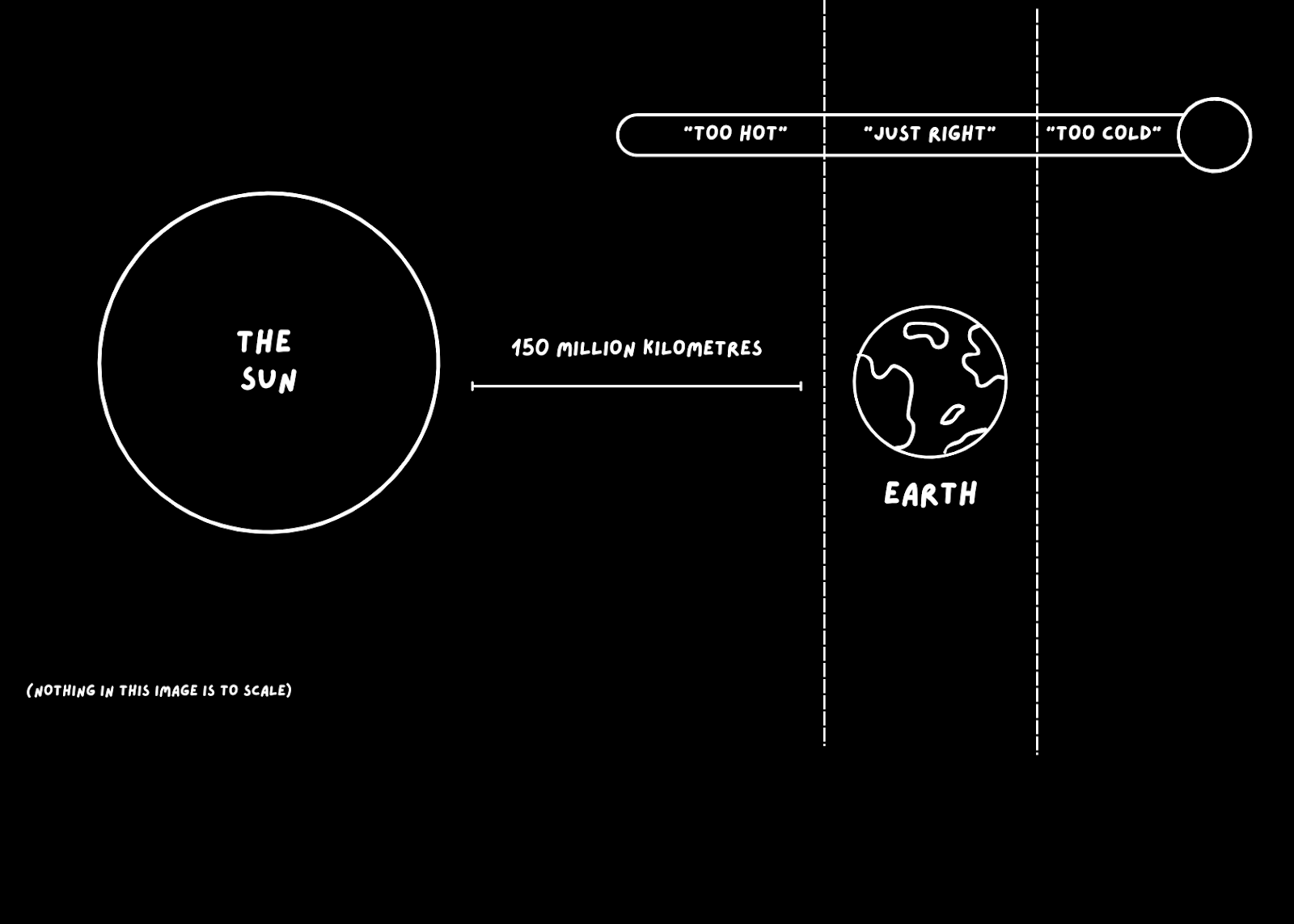
The habitable zone describes the region around a star where conditions may allow liquid water to exist on a planet’s surface for a geologically significant period of time. Often referred to as the Goldilocks zone, it represents an orbital sweet spot. Earth orbits the Sun at an average distance of approximately 150 million kilometres, where our planet receives sufficient solar radiation to sustain stable oceans of liquid water.
Carbon forms long, stable molecular chains capable of storing information and catalysing reactions. All known life on Earth is carbon-based and depends on liquid water as a solvent, making it a fundamental prerequisite for life as we know it. It is this biochemical dependence that elevates liquid water to a primary criterion in the search for life across our Solar System and beyond.
An intricate combination of features makes Earth well suited for complex, carbon-based life that depends on liquid water and moderate surface conditions. This raises an important question: when we search for life beyond our planet, are we looking for life in general, or for life like our own? The concept of the habitable zone reflects a human-centred framework, defined largely by the presence of surface liquid water because that is what terrestrial life requires.
Our instruments are calibrated to detect atmospheric oxygen, methane, water vapour, and carbon dioxide—potential bio-signatures associated with terrestrial biology. We envision oceans, continents, and temperate climates because these formed the environmental backdrop for life on Earth. The language we use—“Earth-like,” “potentially habitable,” “second Earth”—reveals an implicit template. The unknown is often interpreted through the familiar.
Life elsewhere may not mirror terrestrial biochemistry. It may exist beneath ice shells, within dense atmospheres, or in chemistries that do not rely on liquid water at all. On Titan, methane and ethane flow across the surface at approximately −179 degrees Celsius. In the subsurface oceans of Europa, tidal heating may sustain liquid water far from direct solar warmth. These environments expand our understanding of habitability and challenge strictly Earth-centred assumptions.
Perhaps the deeper question is epistemological. We search for what we can recognise. Our biology shapes our imagination; our imagination shapes our science. In seeking life beyond Earth, we inevitably begin with reflections of ourselves. Yet the Universe may harbour forms of organisation and complexity that fall outside our current conceptual vocabulary. To find them, we may first need to broaden what we mean by “life” itself.