
The View from Nowhere
Written by Isla Madden
In 1990, Voyager 1 captured an image of Earth against the backdrop of a vast expanse. This image of our “Pale Blue Dot” compressed every human story into a fraction of a pixel. The fragile view of our entire world exposed how we instinctively imagined ourselves at the centre of the frame. In truth, we are local phenomena attempting to understand a non-local reality. Our presence is neither the purpose nor an error of the cosmos.
The anthropic principle began as a reminder of observational selection effects. We observe a Universe compatible with life because observers can only exist in such a Universe. This is logically true and scientifically useful. When cosmological constants appear finely tuned for the emergence of galaxies, stars, and chemistry, the anthropic explanation reassures us. Of course the Universe allows life, otherwise we would not be here to notice.
This reasoning can quietly shift from explanation to narrative. Instead of asking why constants have particular values, we may stop at the fact that they allow our existence. The question dissolves into inevitability. The danger is not that the anthropic principle is wrong, but that it can prematurely close curiosity. It risks turning a mystery into a tautology. The anthropic principle is a philosophical mirror which reflects our human discomfort with contingency.
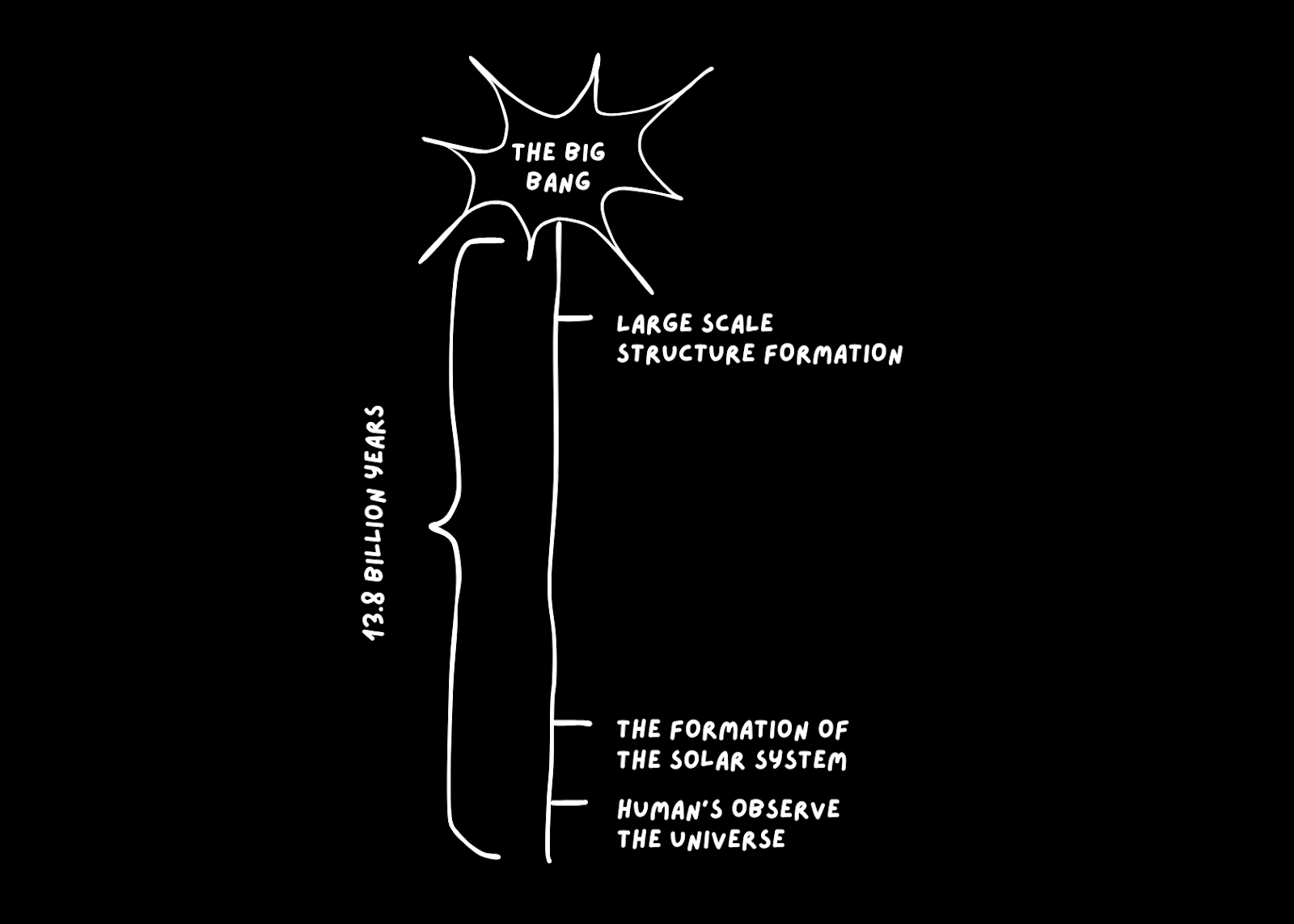
We frame the history of the Universe as a narrative that eventuates in us. The Big Bang as a beginning. Star formation as preparation. Physics does not grant narrative privilege, and the Universe did not begin for observers. For most of cosmic history, there were no observers at all. This perspective disrupts the quiet assumption that intelligence represents a climax. Cosmology offers no evidence that consciousness is the intended endpoint of cosmic evolution. Our presence may be a fleeting phase rather than a culmination.
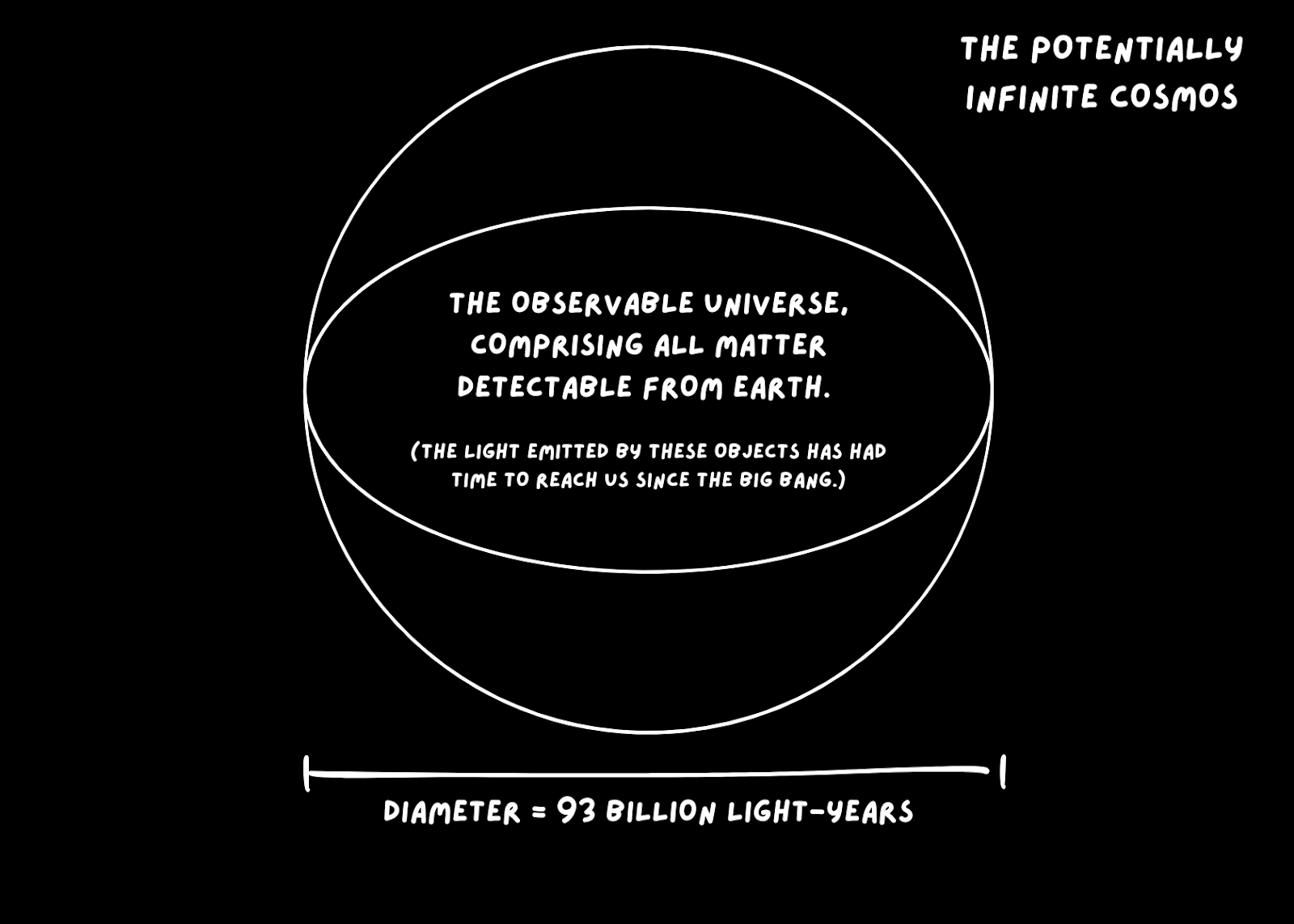
We refer to the observable Universe as though it were the whole. This spherical, continuously expanding region of space contains only the light that we may detect from Earth—the objects whose light has had enough time to reach the Solar System since the Big Bang. It extends about 46.5 billion light-years in radius, yet only constitutes a small portion of the broader, and possibly infinite, Universe.
The observable Universe becomes “the Universe,” not because physics demands it, but because human cognition prefers finite containers. Copernicus removed Earth from the centre of the solar system. Modern cosmology removes even the observable Universe from conceptual centrality. The Universe is not obligated to feel meaningful. Meaning emerges because we ask for it.
Quantum physics introduces another subtle human bias. Popular explanations often emphasise the role of the observer in shaping physical reality. While technically rooted in measurement theory, this idea is frequently interpreted as placing human consciousness at the centre of physics itself. In practice, quantum mechanics requires measurement, not human awareness. The language of observation invites anthropocentric interpretation. We hear “observer”, and we automatically imagine ourselves.
Science strives for what philosophers call the “view from nowhere,” a perspective that removes personal vantage points from the description of reality. Complete detachment may be impossible. Humans build theories using human minds, human metaphors, and human language. Recognising this bias is not a failure of science, but an extension of it. Each time we identify a hidden assumption, we widen the frame.