
On Quantum Physics and Awareness
Written by Isla Madden
Awareness is distinct from attention, and cognition can occur without conscious awareness through processes such as priming and implicit memory. Awareness itself may not be something we possess, but a state we enter. This tension invites deeper questions about the nature of experience and has contributed to the revival of panpsychism, which proposes consciousness as a fundamental property of matter, rather than an emergent byproduct of complexity.
Physics enters the discussion when the nature of reality itself is questioned. Time, in physics, is treated as a dimension; in conscious experience, it is felt as a continuous flow. This discrepancy suggests that awareness shapes reality as it is lived, rather than merely reflecting an objective external world. Our experience may therefore occupy a different explanatory level from physical description alone.
In quantum mechanics, the observer problem challenges classical assumptions, as measurement appears to influence physical outcomes. This has led some to speculate that consciousness may be as basic as space or time—embedded within the fabric of the Universe rather than arising from biological organisation. If reality is fundamentally informational, this awareness is the means through which information becomes subjectively experienced.
The Orchestrated Objective Reduction model, developed by Roger Penrose and Stuart Hameroff, suggests that quantum activity within neuronal microtubules could play a role in awareness. These hypotheses remain controversial, with many neuroscientists arguing that classical neural dynamics can account for cognition without invoking quantum effects.
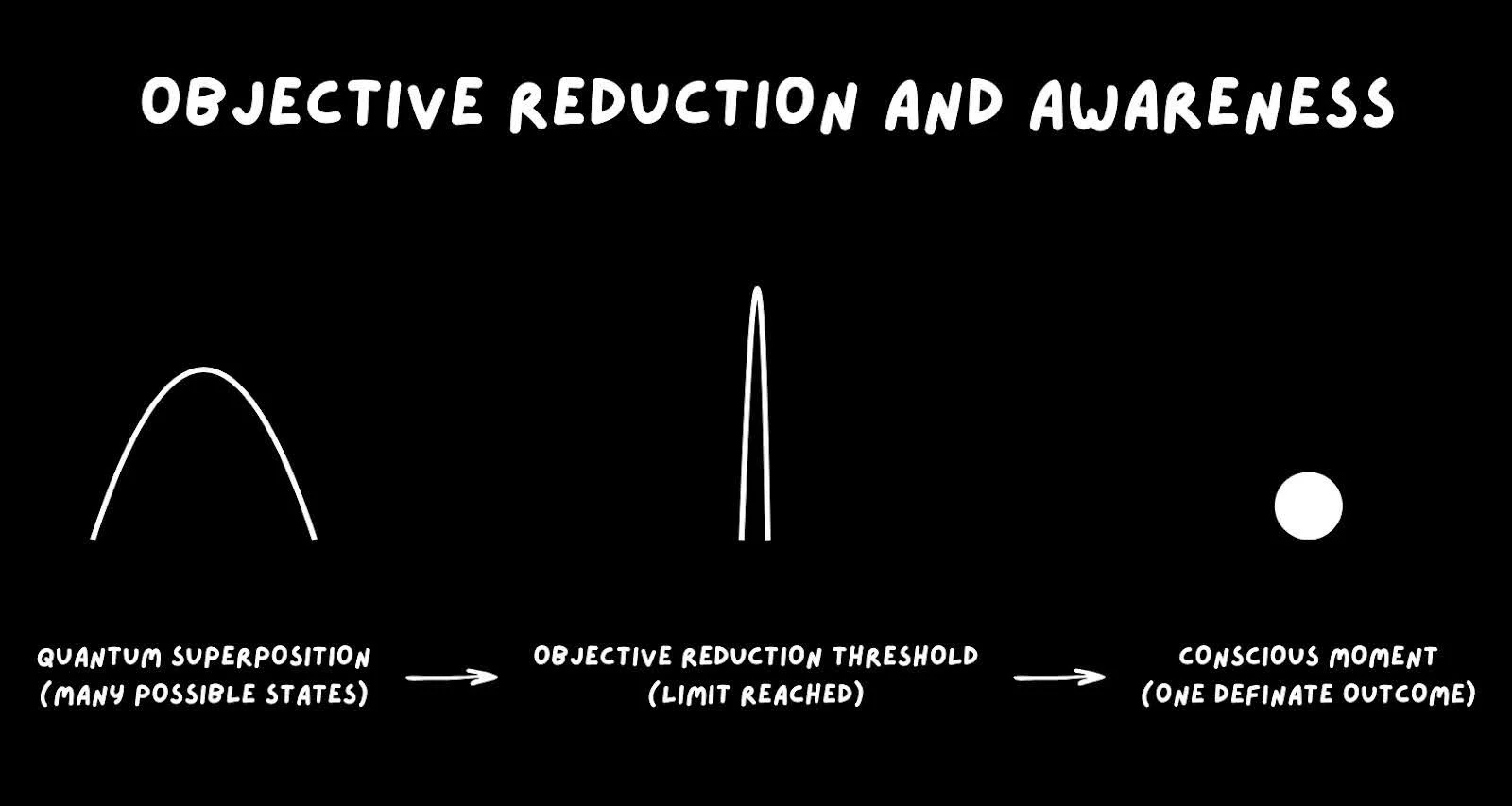
While quantum phenomena challenge classical notions of locality, causality, and determinism, quantum mechanics alone does not resolve the hard problem of consciousness. Randomness and indeterminacy cannot, by themselves, generate subjective experience. True awareness appears to require integration, coherence, and self-reference—features most evident at macroscopic neural scales rather than at the level of subatomic particles.
Ultimately, quantum physics may not explain consciousness so much as reveal the boundaries of explanation itself. It destabilises purely mechanistic accounts of reality, yet stops short of accounting for experience. The elusive nature of awareness in us and the Universe remains neither reducible to physics nor separable from it, occupying a conceptual space where scientific description encounters its limits and philosophical inquiry becomes unavoidable.