
The Universe as Information
Written by Isla Madden
Advances in theoretical physics and information theory propose a Universe that is fundamentally informational. The idea of information as a primary building block from which physical phenomena emerges challenges classical intuitions. Perhaps the fabric of existence is less like solid substance and more like encoded structure.
The holographic principle was first developed through work by Gerard ’t Hooft and Leonard Susskind. This principle proposes that all the information contained within a region of space can be described by data encoded on its boundary. In effect, a three-dimensional volume may be mathematically equivalent to a two-dimensional surface. This notion arose from attempts to reconcile gravity with quantum mechanics. The principle implies a profound equivalence between information and physical reality, where space itself may be a derived concept rather than a fundamental one.
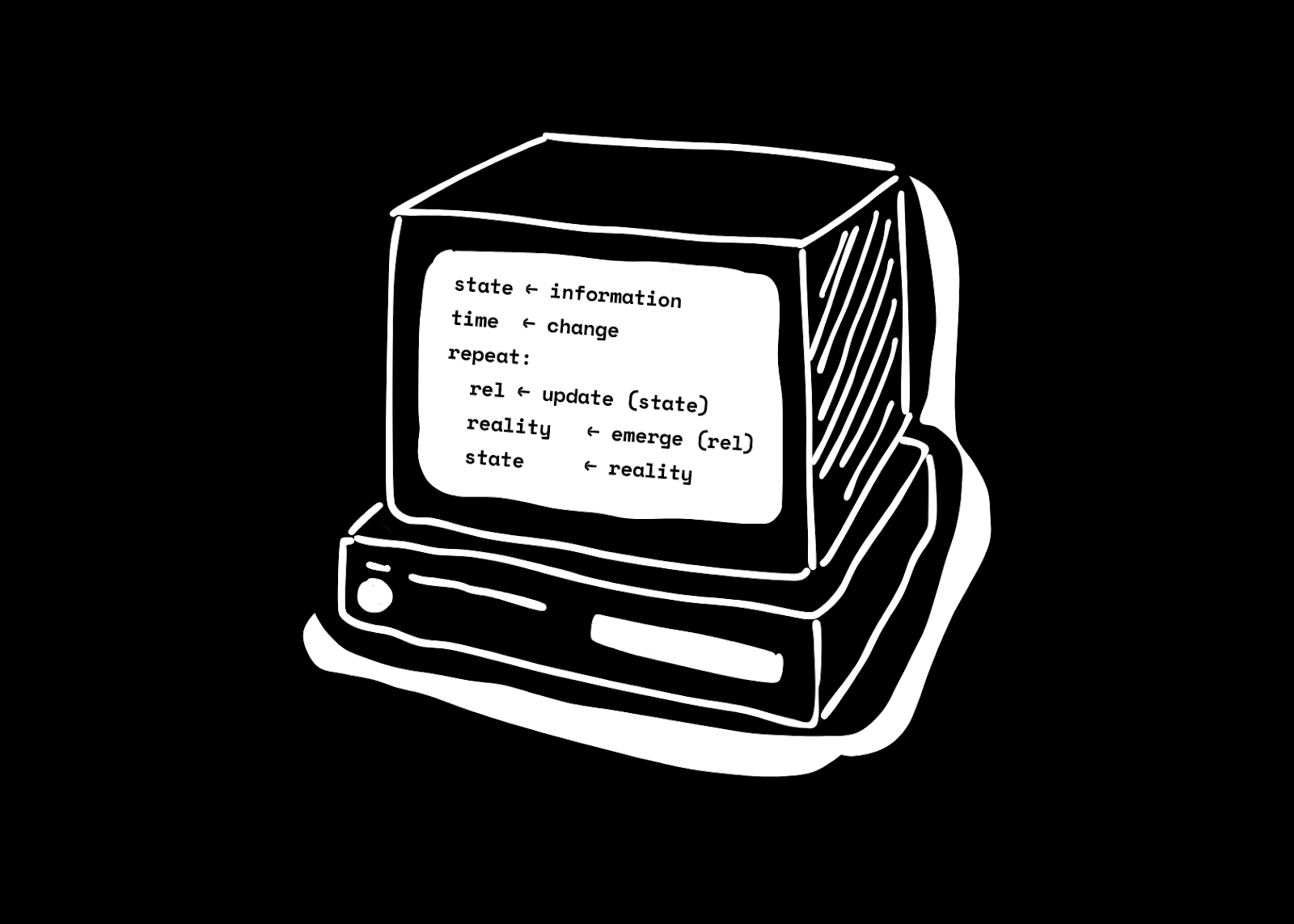
Pioneered by thinkers such as Konrad Zuse and later developed by Edward Fredkin and Stephen Wolfram, digital physics suggests that the Universe operates like a computational system. In this view, space, time, and matter emerge from discrete informational units evolving according to underlying rules, much like a cellular automaton. Physical laws are no longer merely descriptive equations, but operational rules governing how information updates over time.
Black holes provide one of the strongest empirical motivations for treating information as fundamental. The Bekenstein–Hawking formula shows that a black hole’s entropy, and therefore its maximum information content, is proportional to the area of its event horizon. This result led to the black hole information paradox: if matter falls into a black hole and later evaporates through Hawking radiation, where does the information go? Most modern approaches to quantum gravity assume that information is conserved, reinforcing the idea that information may be a fundamental component.
Viewing the Universe as information also raises philosophical questions. If reality consists of informational patterns, what distinguishes physical events from abstract data? Integrated information theory (IIT) suggests that consciousness may arise from specific forms of information integration, though this remains controversial and largely untested at a cosmological scale.
The informational perspective reshapes metaphysics and epistemology alike. If space-time is emergent and physical laws are computational rules, reality becomes a network of relational information. What exists, in this framework, cannot be fully separated from what can be represented, processed, and known. On the broadest scale, physics converges with philosophy, pointing toward a Universe that is not merely described by information—but constituted by it.