The Limits of Understanding Consciousness
Written by Isla Madden
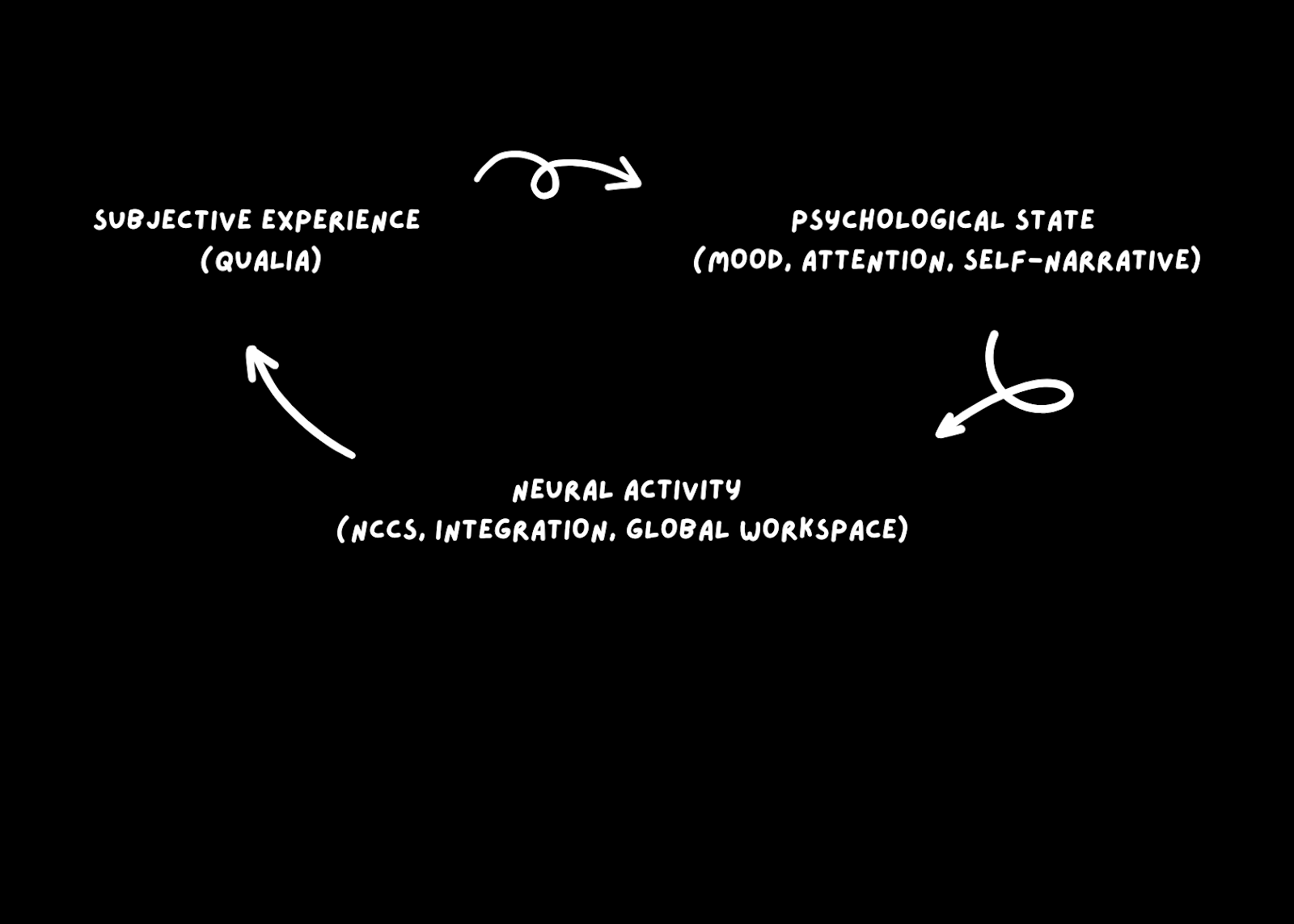
Psychology can measure behaviour and reportable experience, yet it struggles to capture the rawness of the human condition. At the centre of this limitation lies qualia—the “what it feels like” aspect of consciousness. These first-person qualities resist objective description. Neural activity and behavioural outcomes can be analysed, yet subjective experience remains inaccessible to external measurement within a Universe described by physical law.
The notion of a single, unified consciousness is challenged by evidence that multiple streams of awareness may arise within one brain. Altered states—such as meditation, flow, and dissociation—demonstrate the flexibility of conscious experience. This variability suggests consciousness is not a fixed property, but a dynamic mode shaped by biological systems embedded within a wider physical Universe.
Neuroscience has identified correlations between brain activity and conscious experience, yet explanation remains incomplete. Neural Correlates of Consciousness, including the default mode network, map regions associated with awareness, but correlation does not imply causation. In the same way that gravity had it’s effect before the rise of Einstein’s pivotal explanation.
Neural activity often precedes conscious decision-making, giving rise to the timing paradox and challenging notions of agency and free will. Theories such as Global Workspace Theory describe how information becomes globally available across the brain, yet they remain silent on why such availability is felt. Physical processes obey deterministic or probabilistic laws, but experience introduces a subjective dimension physics cannot yet accommodate.
Physics complicates the picture further. Time, in physical theory, is a dimension; in consciousness, it is experienced as flow. Quantum mechanics challenges classical assumptions through the observer problem, where measurement appears inseparable from outcome. These features suggest that consciousness may not merely exist within the Universe, but participate in how reality is encountered and structured.
Philosophy names the problem science cannot yet resolve. Consciousness may be an illusion, yet even an illusion requires experience. Language, shaped by evolutionary utility, may be insufficient to capture phenomena that sit at the limits of physical description. Consciousness cannot be observed externally; it is the one phenomenon through which all observation occurs.
The study of consciousness therefore exposes the limits of explanation across disciplines. Even if physics constrains its possibilities, it does not dissolve its mystery. Consciousness emerges at the intersection of physical law, biological structure, and subjective awareness—a phenomenon that both arises within the Universe and reflects upon it, resisting complete reduction to its parts.