Symmetry and the Laws of Nature
Written by Isla Madden
Albert Einstein famously described the theory of relativity as “beautiful” in its mathematical form, reflecting a deep satisfaction beyond mere empirical accuracy. Perhaps the notion of beauty in physics is not purely subjective but closely tied to the structure of reality itself. Symmetry plays a central role in modern physics, not just as conceptual elegance but as a principle constraining the possible laws governing particles and forces.
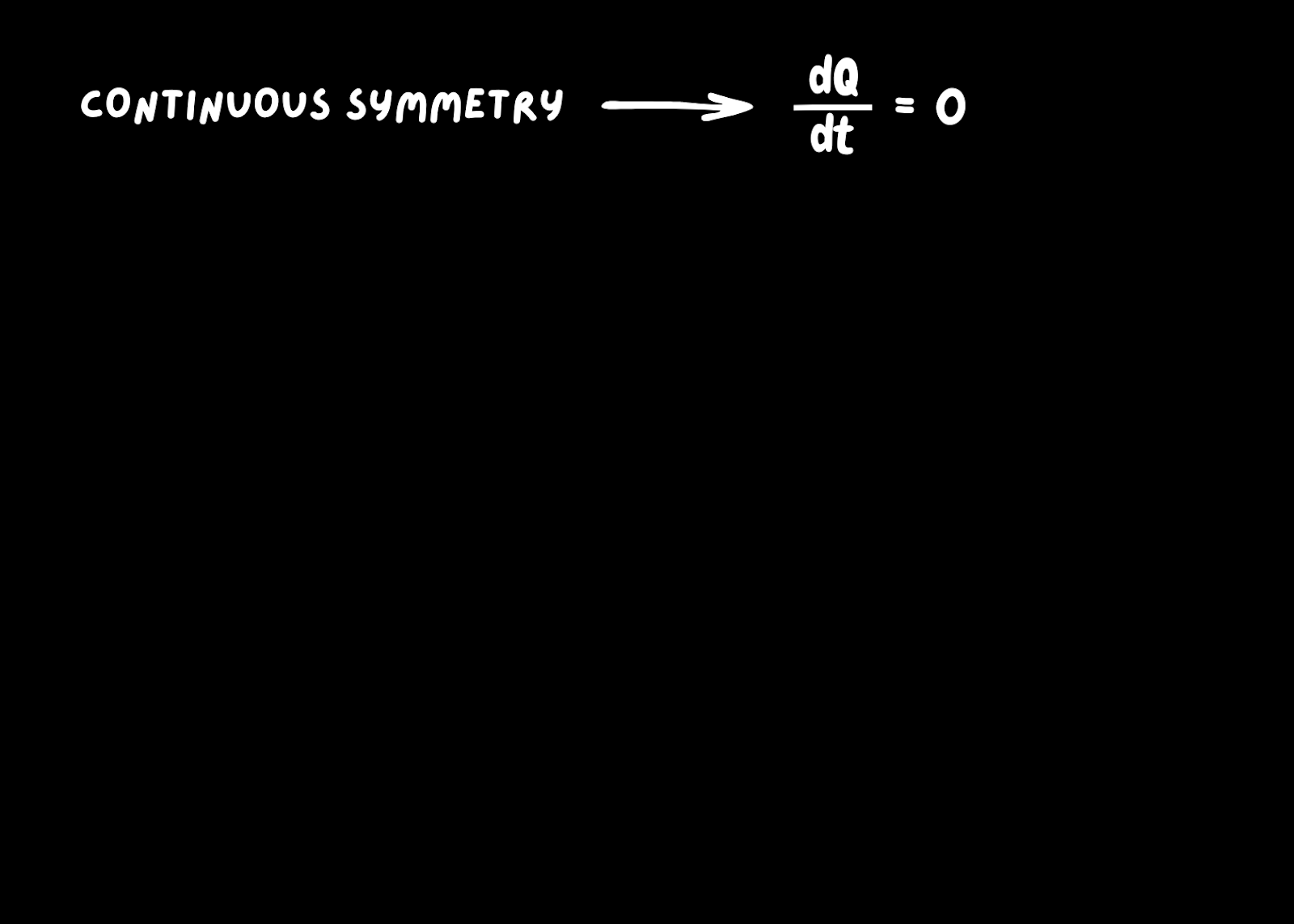
The profound link between symmetry and conservation laws is formalized in Noether’s theorem. Emmy Noether demonstrated that every continuous symmetry in a physical system corresponds to a conserved quantity: time translation symmetry results in conservation of energy, spatial translation symmetry gives conservation of momentum, and rotational symmetry leads to conservation of angular momentum. In this sense, the universe’s order is not random but mathematically structured, suggesting that beauty and law are deeply intertwined. The patterns we find elegant may be elegant precisely because they capture these underlying regularities.
In modern theoretical physics, symmetry continues to guide understanding. Quantum field theory and the Standard Model are organized around symmetry principles. Gauge symmetries dictate interactions between fundamental particles, while symmetry breaking explains why the universe exhibits the diversity of phenomena we observe. Without these symmetries, physical laws would lose coherence; the stability and predictability of the cosmos depend on these hidden regularities.
Philosophically, symmetry has long been associated with order and balance. In Platonic philosophy, abstract forms represent perfect order: geometric shapes and mathematical truths are eternal, unchanging, and symmetrical “ideals” that physical reality imperfectly imitates. Structural realism similarly suggests that science captures not the “stuff” of reality itself but its underlying mathematical structure. Symmetry and order in physical laws reflect the universe’s real structure, emphasizing consistent relational patterns between its parts. Ideas of teleology or design also invoke symmetry as evidence of rational order in nature.
These consistent patterns, observed across physics, biology, and cosmology, suggest an underlying orderly principle inherent in the universe. This raises a profound question: is the universe inherently beautiful, or do humans project aesthetic values onto our models? While our perception of elegance may influence which theories we find plausible, the objective constraints imposed by symmetry indicate that beauty in physics is not merely subjective. The laws of nature are not only empirically grounded but also expressions of a deeper, intelligible order, revealing a universe that is both elegant and comprehensible.